
The Envolvimentos (Involvements) fostered an open dialogue with social movements and diverse territories, converging on the exhibition of the 14th São Paulo International Architecture Biennial, which runs from September 18 to October 19 at OCA in Ibirapuera Park. Architects and leaders from villages, terreiros, riverside communities, and peripheral neighborhoods jointly explored architectures for inhabiting a heated world in debates that deepened the exhibition's central ideas.

Participants involved in projects across diverse territories and contexts addressing issues such as coexistence with water and floods, heritage preservation, forest protection and sustainable management, urban agriculture, mechanisms for enabling low-impact lifestyles, and the recognition of nature as a subject of rights were invited to participate in the dialogue. These are ways of inhabiting, building, perceiving, participating in, and transforming the territory.

Guests:

Jean Ferreira
Belém, PA

From the Jurunas neighborhood of Belém, Pará. He is a co-founder of Gueto Hub and COP das Baixadas, co-curator of public programs for the 2nd Amazon Biennial, and an activist for access to culture, memory, and the climate debate for the peripheries.

Jerá Guarani
Sao Paulo, SP

Jera Guarani, leader of the Kalipety village in the Tenonde Porã Indigenous Territory, in the far south of São Paulo. With a degree in Education, she works as an Environmental Agent, promoting the recovery of traditional seeds, degraded areas, and forests on Indigenous land.

Mother Carmen of Oxalá
Guaíba, RS

Mother Carmen de Oxalá, a Rio Grande do Sul ialorixá, is vice-president of the Rio Grande do Sul State Council of Culture and a member of the Executive Committee of the National Commission of Cultural Points (CNPDC). She is active in combating religious intolerance and holds a degree in Psychology.

Marcele Oliveira
Rio de Janeiro, RJ

Producer, communicator, and climate activist, she was a member of the Realengo 2030 Agenda and is the executive director of Perifalab. Her research focuses on climate justice and environmental racism, focusing on the occupation of public spaces and the right to the city, with a focus on culture and climate.

Urban mobility is an essential component of people's everyday activities, and is directly affected by the rapid increase in the urban population, unplanned urbanization, and the changing socioeconomic conditions. It is a major determinant of quality of life, public transit, employment, education and health care. Furthermore, having access to efficient urban mobility systems remains one of the fundamental issues for policy makers, especially in large cities and densely populated neighborhoods. To address some of these challenges, shared mobility – urban planning nexus offers opportunities for enabling spaces for collaborative urban planning and governance practices. Such nexus can serve as a vehicle to explore the changing dynamics of urban challenges during which experimentation is used to inform urban practice. Our session focuses on how the application of this approach in cities can contribute to the sustainable transitions of urban mobility systems while promoting active mobility and energy transition in public transport.

Presentations:

Toward inclusive transitions: gender-sensitive street design and public bike-sharing as drivers of shared mobility in Oaxaca
Luis Alfonso Barraza Cardenas

Social and urban regeneration Rua Rainha Ginga
Julio Abrantes

Urban disconnections and inequalities nexus: voices from the ground
Ana Paula Koury, Jessica Souza and Luciano Abbamonte da Silva

Urban sounds and mobility
Pedro Silva Marra

Shared mobility – Urban planning nexus for accelerating urban mobility system
Aksel Ersoy and Diego Hernando Florez Ayala

Free

Registration

Registrations must be made here.

Selection will be made in order of registration.

Registration will be open until the start of the activity, on site, as long as there are spaces available.

Project implementation: Brazil
Project development: Brazil

(RE)PROGRAM AND (RE)CONSTRUCT THE CROSSINGS OVER THE RIVERS OF SÃO PAULO

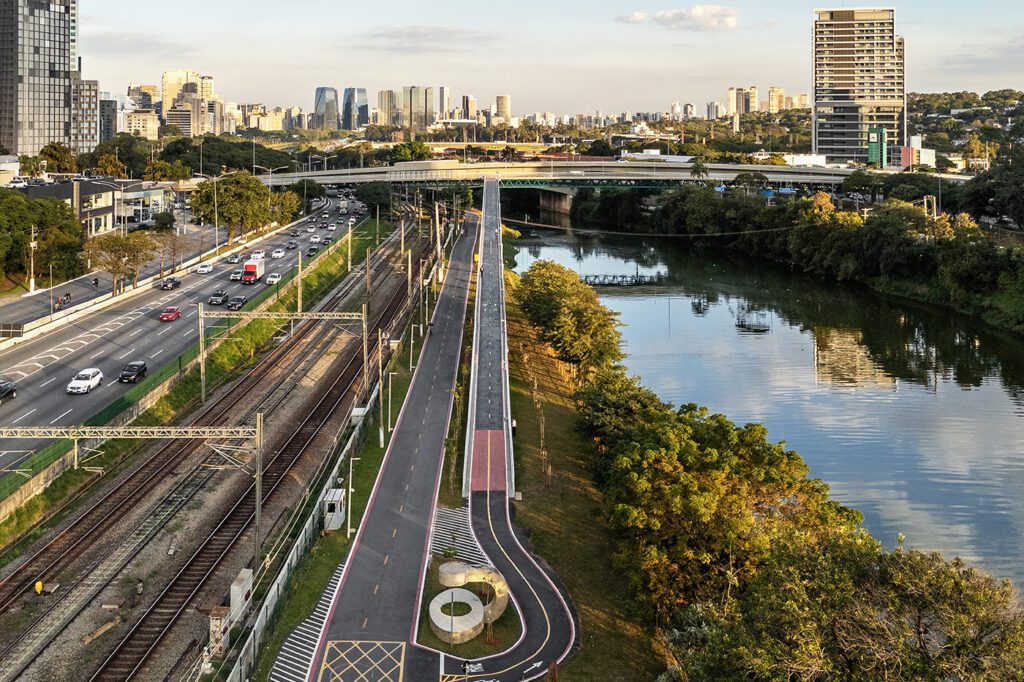
The Erika Sallum Footbridge project began with a proposal submitted in 2014, responding to a call from the São Paulo City Hall within the Arco Tietê Urban Perimeter. We chose to study urban crossings over rivers and identified striking social, economic, and cultural inequalities between the riverbanks. This situation is exacerbated by the scarcity of well-located bridges that prioritize private vehicles and neglect pedestrians and cyclists. At the time, of the 62 crossings over the Pinheiros and Tietê rivers, none were dedicated to active mobility—a worrying situation in a city where a third of the population commutes on foot.

Our proposal was selected, creating São Paulo's first cycle walkway, connecting the dense and popular neighborhoods of Butantã and Pinheiros. From the outset, we sought to ensure that the bridge's headlands would act as activating elements of public space, connecting public transportation, sidewalks, and cycle paths. We prioritized safe and comfortable access that would encourage daily use of the crossing. The walkway was designed as a wide, pleasant, and contemplative walkway, offering privileged views of the city, the mountains, and Jaraguá Peak.

The structure features a central access point that connects directly to the Marginal Pinheiros bike path, extending its use on weekends and for leisure activities. Because it's located in a high-traffic area, the construction used prefabricated elements: a main metal truss and a concrete platform. The initial sections were cast in situ on the flowerbeds, while the sections over the river and avenues were divided into nine metal sections, hoisted overnight, and precisely positioned on concrete pillars.

The rapid appropriation of the footbridge by the population demonstrates the transformative potential of well-planned urban infrastructure. More than just a crossing, it has become a symbol of the importance of public investment in active mobility and the improvement of urban spaces, promoting more sustainable modes of transportation and strengthening collective life in cities.

Virtual Tour of the 14th BIAsp 

The 14th São Paulo International Architecture Biennial, Extremes: Architectures for a hot world., It has expanded beyond physical space and can now be visited from anywhere! 

The virtual tour offers a new perspective on the exhibition, which took place from September 18th to October 19th at the Oca in Ibirapuera Park, allowing for fluid, free, and intuitive navigation between the different spaces. During the visit, curatorial content, high-definition images, and details that deepen the spatial and conceptual understanding of the artworks are available. 

The platform broadens access, preserves the memory of the Biennial, and creates new ways to experience architecture. 

Visit the 14th BIAsp here!  

Explore at your own pace, revisit routes, and deepen your experiences. 

The virtual tour will soon be available on the IABsp (Brazilian Institute of Architects – São Paulo branch) website.